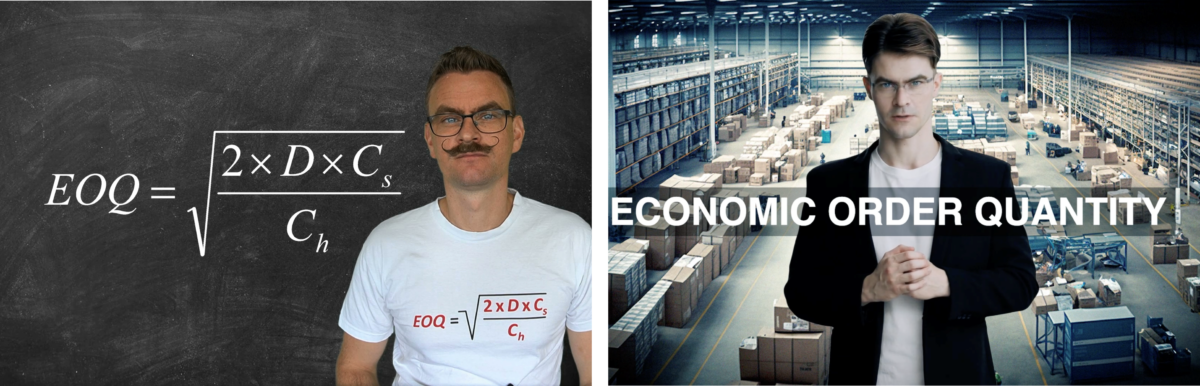
Fig. Human-made vs. AI-generated teaching video on the concept of Economic Order Quantity
Same same but different
Contrary to our hypothesis, the results showed no statistically significant differences in exam results for the AI-generated versus human-made videos. Hence, ultimately, the students learned the same in our experiment. This result may serve as a wake-up call for teachers who see themselves as irreplaceable in learning settings.
However, in agreement with our hypothesis, the students reported that they enjoyed the human-made videos more than the AI-generated equivalents. The reduced enjoyment of AI-generated videos may stem from the absence of a personal connection and the nuanced communication styles that human educators naturally incorporate. Such interpersonal elements may not directly impact test scores but contribute to student engagement and motivation, which are quintessential foundations for continued studying and learning.
While our study has shown the potential for AI-generated educational videos, we note that more experimentation and research are needed before broad-brush conclusions can be drawn about generative AI’s potential in teaching. We only tested learning effects among an online panel of gig workers incentivized with a small payment for participating in our study. Further, we tested the effect of short AI-generated educational videos on topics on which consensual information is available on the internet.
Nonetheless, considering that AI is rapidly developing, our study provides an early indication that educational videos can soon be outsourced partly or entirely to generative AI technology. For example, teachers might consider using AI-generated videos for knowledge transfer of basic concepts, thereby freeing up time to focus on more personalized instruction and classroom time. Our results hint that teachers should integrate AI tools in a manner that seeks to complement, rather than substitute, the human touch in teaching. One thing is sure: With the rise of generative AI, it’s time to rethink many teaching tasks besides video generation.
Editor’s note: this article is based on the research published in Netland, T., von Dzengelevski, O., Tesch, K., & Kwasnitschka, D. (2025). Comparing human-made and AI-generated teaching videos: An experimental study on learning effects. Computers & Education, 224, 105164, https://doi.org/10.1016/j.compedu.2024.105164
Author