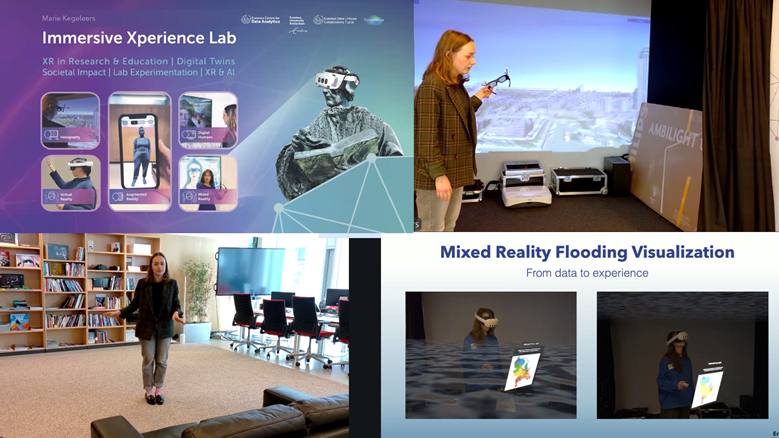
Marie Kegeleers runs the Immersive Xperience Lab at Erasmus University Rotterdam, a lab dedicated to exploring how immersive experiences can bridge the gap between technology and society.
Marie took us through a set of learning spaces that are deliberately positioned at the intersection of technology and society. She explained the lab’s position of framing immersive technologies not as ends in themselves, but as tools for exploring human behavior, decision-making, and public impact.
She showed how the lab builds “data experiences” that make complex systems tangible. One example was the use of campus Wi-Fi data to visualize patterns of movement and space usage – transforming abstract datasets into narratives that help us reflection on how students actually move through the university. This is also used in larger-scale applications, such as urban planning simulations and a digital twin of Rotterdam. This is projected onto a holographic wall that supports shared, collaborative exploration rather than isolating users in headsets.
They emphasise collaboration since the lab does not overly rely on fully immersive, individual XR setups. Instead, they combine several devices, from VR headsets to smart glasses and large-scale projection environments. This helps them create experiences that can be discussed, questioned, and interpreted in real time. Immersion in higher education is not only about realism, but about participation.
The lab tries to operate at the edge of the curriculum, rather than being fully embedded within it. Student engagement usually happens through workshops and exploratory sessions. At one point, over 150 students participated in a single week. These sessions are often done in partnership with external organizations. This is a flexible and outward-facing approach. There are limited internal resources but these are balanced by strong regional collaboration. Erasmus has set up a number of external partners across South Holland. This immersive network finds ways to share facilities, such as the Cotton House XR hub.
Marie showed a few applied cases and the lab’s potential to impact outside the university. In greenhouse environments, mixed reality overlays allow workers to visualize live data in situ which can speed up onboarding. In another case, a lightweight mixed reality application simulates flooding scenarios, enabling users to see what happens when infrastructure fails. Although these immersive technologies are not yet mainstream, they can help extend learning into places that may be inaccessible or too abstract.
According to Marie, universities do not need to build comprehensive XR infrastructures from scratch. By partnering with regional hubs, renting specialized equipment, and working with external experts, they have found a way to be share costs and equipment. In this exploratory phase, they are testing, identifying use cases, and understanding where they can move beyond the hype, and really add value with immersive learning.
Conclusion
There were several detailed questions from the audience on technical aspects. In our closing reflection, the panel looked at where we are in the process of standardization. Although we are not there yet, there are still many opportunities to experiment in meaningful ways. This webinar was an opportunity to get insights into that. The next step will involve moving from these interesting demonstrations into a pedagogical model that is well thought out, constructively aligned with course goals, and closely linked to the affordances of the various technologies.
Previous tours
Disclosure: this is a subject very close to my heart! As a member of the Media and Learning advisory committee, I have been involved in several of these webinars over the years. See my previous reports on virtual tours of advanced learning spaces here:
Feb 2025
Feb 2024
May 2023