Motivation to study in Croatia
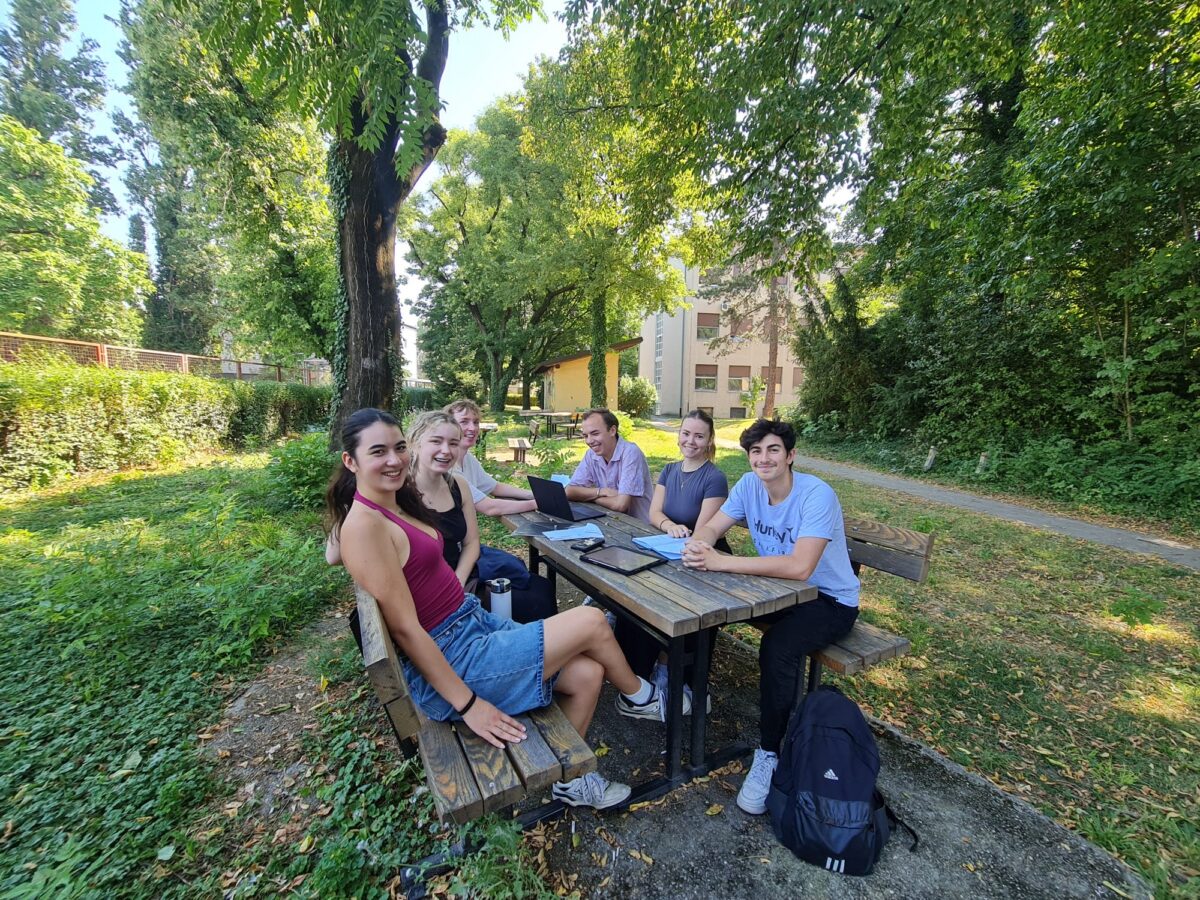
At the beginning, the students shared their specific reasons for enrolling at the Faculty of Veterinary Medicine in Zagreb. Mia (Japan/Australia) explained that her father grew up in Australia, where his parents had immigrated from Croatia; however, she herself grew up in Japan. She had been looking for English language programmes around the world, came across Croatia, applied, and was accepted. She particularly likes intensive, small group classes, which allow for an individual approach by professors. In this course, 32 second-year students are divided into three groups of about ten students each.
Olivia is originally from the USA but grew up in England. She described her arrival in Croatia as “accidental” and “without any special story”, but she really enjoys her studies. Drawing on Professor Kužir’s argument, she herself also pointed out that it was very important for the Faculty of Veterinary Medicine to be a member of The European Association of Establishments for Veterinary Education, as well as the fact that it is easier to enrol in Croatia than elsewhere – with the possibility of working anywhere after graduation. She is surprised that in Croatia students can address professors by name (I am surprised too!) and by the general level of informality in communication, especially compared to the private education system in England.
Finley, who comes from the same education system, shared that his A-level scores initially didn’t meet the criteria for entry into English universities. So, he decided to retake the state graduation exam (the so-called A-levels in England) and, in the meantime, began considering European universities – hesitating between Budapest and Zagreb. Thanks to a friend from school who had moved to Zagreb earlier, he visited the city and liked it so much that he decided to study in Zagreb too, despite being accepted to a university in England in the meantime.
After Finley, I spoke to Erik, who comes from Germany. His decision to come to Zagreb happened quickly, because he didn’t worry too much about university applications while taking his high school graduation. When the exams passed, most of the deadlines for applying to European universities were closed, so his options were either Budapest or Zagreb. Budapest offered a German-language programme for the first two years, after which he could transfer to Germany. However, Erik’s desire was to step out of the “comfort zone” of his native language and enrol in the Veterinary Faculty in Zagreb.
Jad tells us about the Lebanese education system. As Lebanon is a former colony, the system is similar to the French one, and it is very difficult to enrol in university studies. Preparations last two years, and the entrance exams are rigorous. As with most of his colleagues, his reasons were also personal and human – his cousin had already graduated from the Faculty of Veterinary Medicine in Zagreb, and that’s how he learned about the University of Zagreb and decided to apply. She is now doing her MA in Belgium, which further motivated him to look for a university in Europe. Like Finley, he appreciates the relaxed and friendly atmosphere in Croatia.
Finally, I meet Maja from Canada. She cites her parents’ Croatian origin as the main reason for coming to Croatia. She found the veterinary medicine programme online, and it was the only university she applied to. She emphasised that it is easier to enrol in Croatia than in Canada where foreign students are often preferred due to the higher tuition fees they pay. She also noted that studying in Croatia is significantly more affordable than anywhere in North America – one year of study in Canada, she says, costs as much as six years in Croatia. She adds that her parents were very happy with her decision, as it helps preserve and pass on the Croatian language and culture.
Comparison of education systems
After getting to know them better, I asked the students to compare the educational systems and teaching methods in their home countries with those in Croatia. When I uploaded the transcript of our interview to Google Notebook and asked it to identify patterns, it quickly recognised the key topics on which students focused.
Professor’s support
A topic that came up early in the conversation was the relationship between professors and students. Mia who was educated in a private English-language school in Japan, is aware that she received an excellent education with access to many technological and material resources. However, she points out that at the Faculty of Veterinary Medicine in Croatia, the relationship between professors and students is much more “friendly” and less hierarchical than in Japan, where a strict hierarchy exists and a special form of language is used when speaking to superiors. She believes that this closeness has a very positive impact, especially on international students. Olivia added that she also came from a private education system and was equally surprised by the possibility of addressing professors by their first name and by the overall relaxed tone of communication – something she said that would be unimaginable in a private school in England. Erik, concluded that despite the education systems being very similar, in Croatia professors tend to “guide” students through their studies, whereas in Germany, students are largely left to themselves.
Flexibility and online learning
Finley was the first to mention the challenging nature of mandatory attendance at all lectures in Croatia (often starting at 7 or 8 a.m.), which he finds both positive and problematic. On the one hand, he appreciates being required to attend and follow the lectures; on the other hand, he considers the system too rigid. Olivia also advocated for greater inclusion of online classes, which were available in the UK and, in her view, would be particularly helpful in cases of illness or family emergencies – especially for international students. In this regard, they feel there is a lack of flexibility and understanding for the specific needs of foreign students.
Professor Kužir explained that hybrid teaching is still not officially regulated in Croatia, but now, with the new equipment and the hybrid lecture hall provided through the e-University project, lectures will be recorded as additional material. This means that students will have access to content if they miss a class.
Mia followed up on this topic, highlighting that the recordings of the lectures with scanned slides would make it easier for all generations of students to study, which is actually the goal that Professor Kužir set for herself.
Integration of universities
Finley felt the need to talk about the lack of connection and integration between the faculties within the University of Zagreb, which creates the impression that the Faculty of Veterinary Medicine is “its own separate university” and that the only people they spend time with and get to know are other students from the Faculty of Veterinary Medicine.
Professor Kužir responded by highlighting two opportunities for connection: the university’s first student magazine, Veterinarian, which also serves as a networking platform, and the option of horizontal mobility – taking elective courses at other faculties to earn additional ECTS credits and meet students from different disciplines. Although I didn’t get the impression that the students felt lonely or lacked a social life, they all echoed Finley’s comment to some degree. It does seem that there is a shared concern about living in a kind of isolated bubble within the Faculty of Veterinary Medicine. When I mentioned the existence of Erasmus student associations, they pointed out that Erasmus students are only in Croatia on a temporary basis, while they themselves are here for the full duration of their studies.
Technology and practical work
Erik is surprised by the advanced technology at the Faculty of Veterinary Medicine in Zagreb, in comparison to Germany, where private faculties and private clinics often have better equipment and therefore have an advantage over state-funded institutions. For example, he described how students of state faculties in Berlin do not have access to night emergency cases precisely because of the lack of such resources. In contrast, the Faculty of Veterinary Medicine in Croatia is a state institution, yet it is also the leading veterinary institution in the country. Jad also believes that Croatia is much more technologically advanced compared to Lebanon.
Quality of teaching
Experiences related to the quality of teaching vary significantly. Jad believes that the teaching methods in Lebanon are somewhat better in terms of of explanation and the demanding nature of the education system, as well as the fact that everyone speaks three languages. Olivia and Mia commented on the differences in quality within the faculty itself, which other students echoed and highly praised courses such as Histology, Anatomy, Chemistry and Biochemistry, and Physiology. These courses are praised for their excellent (genuinely incredible) lectures, good organisation and the professors’ willingness to answer student questions. Finley noted that the courses carrying the most ECTS credits are often the most interesting. However, the group agreed that some other departments lack the same level of organisation, and they find it difficult to see the value in seminar classes for courses they consider less important – where they feel they spend too much time on passive reading and preparing presentations.
Oral exams
At the end of the comparisons, Maja pointed out that oral exams are a major difference compared to Canada, where there are no exams at all. Although she considers them extremely stressful, she admits that they are useful because they mean that learning material is retained better.
In the third part of the interview, we talked to the students about their experience using the studio for recording podcasts.
Initial discomfort and motivation to record
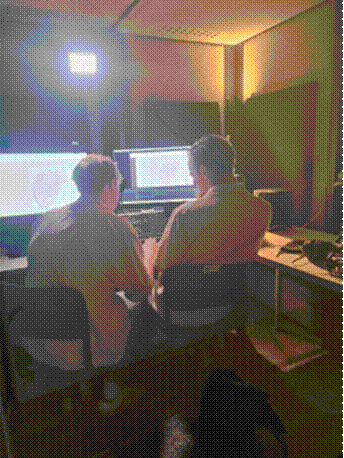
It is interesting how the students invited each other to the recording to reduce discomfort and overcome fear. Mia told us how she felt at first because of the very idea of recording in the studio – “scary idea… no one’s really done that before” and that she asked Olivia to join her to make it easier for her. In the end, they were both happy that they did the recording and that it felt like “talking to a friend in a small, cozy room” (it’s a Studio in a Box – a chamber for recording podcasts, lectures, video lessons, etc.). Jad, who was invited by Finley, also shared that he wasn’t particularly keen on the idea at first, especially if the recording was going to end up online. Finley, on the other hand, said the initial invitation to participate – extended by Olivia – sounded like it would involve a lot of work, which further discouraged him. However, the key moment for everyone was a conversation with Professor Kužir, who encouraged them with a simple “You can do this” and helped change their minds. Realising that it was mostly an audio recording and not a video of themselves further eased their initial fears and helped them gain a new educational experience.