by Jonathan B. Singer, Loyola University Chicago, USA and Mim Fox, University of Wollongong, Australia.
We know the social work classroom is changing. Students are balancing jobs, caregiving, and field placements, often accessing course content between shifts or on the go. As educators, we’re constantly looking for ways to meet students where they are without compromising depth, ethics, or critical engagement. That’s what first drew us to podcasting.
When we started podcasting, even though we were practitioner-educators, we weren’t thinking about podcasting as pedagogy. We were following our instincts grounded in the ethics and values of social work: relationality, justice, reflection, and voice. The more we worked with the medium, the clearer it became: podcasting wasn’t just supplemental. It could be central to a values-driven, theoretically grounded pedagogy.
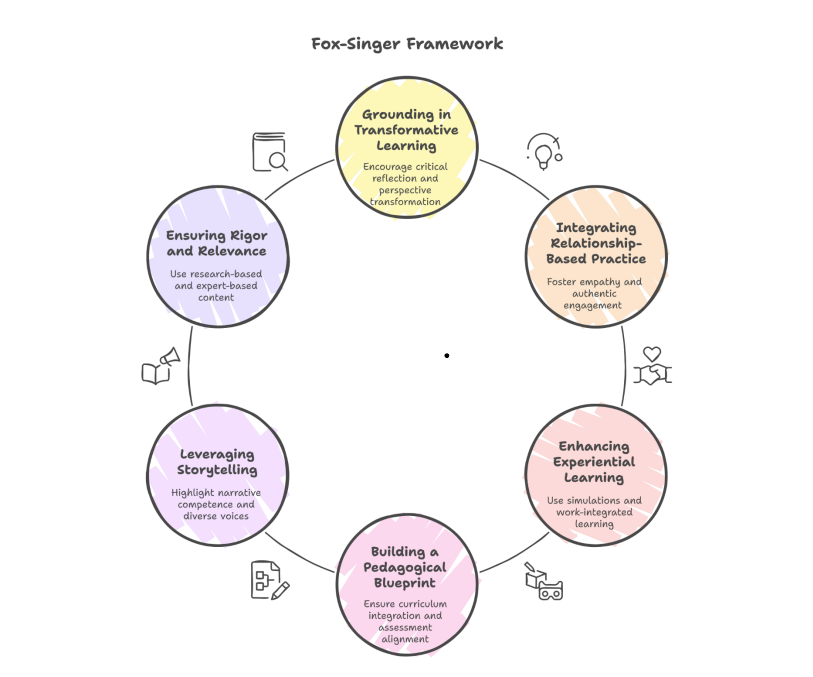
From these experiences emerged the Fox-Singer Framework for Podcasting in Social Work Education, a model we developed for our 2025 text Podcasting in Social Work Education to help higher education instructors use podcasting intentionally and effectively in the classroom. The framework aligns with well-established teaching theories and social work principles, offering a concrete way to integrate podcasting without turning it into busywork or background noise.
Why podcasting belongs in Higher Ed
Podcasting is intimate. We record our episodes assuming that almost every episode will be experienced as an audience of one. When students listen, they’re often alone with earbuds in, commuting, cooking dinner, exercising, or following along with the transcript. They’re not scrolling through slides, watching a Zoom recording, or flipping through social media. They are in the front seat at a conversation made just for them.
Hearing someone’s real, unfiltered, emotional voice has a unique ability to cut through abstraction and foster connection. That matters in education. Especially in disciplines like social work, nursing, education, and public health, where developing empathy, critical thinking, and cultural humility is essential. We’ve found podcasting supports those learning outcomes powerfully – not as a gimmick, but as a tool for reflection, challenge, and transformation.
The Fox-Singer Framework: A brief overview
The Fox-Singer Framework (Figure 1) outlines six key constructs that support podcasting as a pedagogical practice in social work education. It’s not about adding podcasts just to seem tech-savvy – it’s about aligning content with transformative learning theory, relationship-based practice, and experiential education.