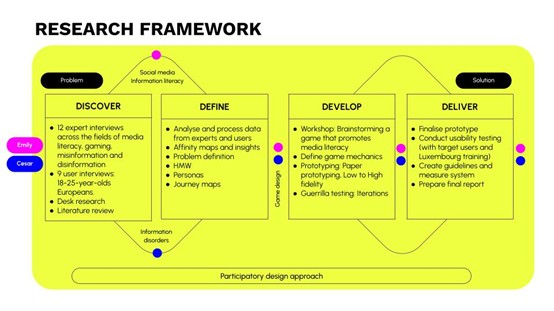
To analyze this behaviour, we utilized the Social Media and Information Literacy (SMIL) framework, which categorises literacy into six dimensions:
- Navigation
- Curation
- Appraisal
- Comprehension
- Creation
- Social Interaction
Our analysis revealed that the core challenge is a breakdown in the Appraisal dimension—the ability to evaluate information and understand media intent. To solve this, we reframed our design challenge:
How might we encourage young adults to critically engage with and assess Instagram and TikTok content through play and games?
Problem Statement
Young adults in Estonia often use social media as a form of distraction, engaging in passive scrolling for entertainment. This pursuit of effortless content reduces critical engagement with information and unintentionally contributes to the spread of misinformation.
3. Develop: Co-Designing for Friction
Central to our design process was co-design with both the target group and experts. We conducted collaborative workshops with young adults, media literacy specialists, and game designers to develop an intervention. To address passive behaviour, we applied the Triadic Game Design and MDA (Mechanics, Dynamics, Aesthetics) frameworks to guide the workshops and balance educational value with enjoyment. During these sessions, participants prototyped game concepts informed by insights from the discovery phase, including:
- Mobile-first & Casual: Short core loops (≤ 20 minutes) for on-the-go play.
- Humour-Driven: Using irony and satire to spark conversation.
- Social & Competitive: Multiplayer modes, voting mechanics, and shareable results.
- Aesthetics: A “childhood game” vibe mixed with modern social media simulation.
These sessions explored how game mechanics can simulate real-world social pressure, ensuring the final solution was genuinely user-centred rather than top-down.
4. Deliver: The Game
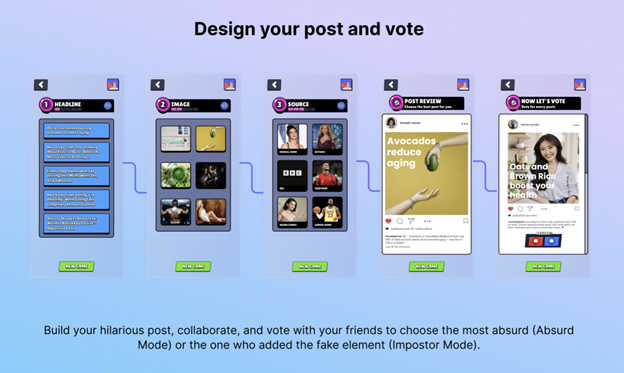
The result is “Fake or Nah,” a digital card game that simulates a social media feed to disrupt passive scrolling. It creates a safe “sandbox” where players evaluate content, turning hesitation into deliberate critical thinking.
The game features three distinct modes:
This digital card game simulates a social media feed to disrupt young adults’ passive scrolling, creating a safe sandbox where players actively evaluate content on politics, well-being, and celebrity gossip, turning hesitation into deliberate critical thinking.
Game Modes
- Mode 1: Absurd, inspired by Cards Against Humanity, has players assemble the most ridiculous social media post using Headline, Source, Data, Likes, and Comments cards. The group votes on the funniest creation, revealing how easily sensational elements can be combined to create “fake news.”