Breakouts
The programme offered five rounds of breakout sessions spread throughout the day, each running for between 25 and 60 minutes, with short breaks in between – an intense yet highly rewarding experience. With several sessions taking place at the same time, it was impossible to attend them all, but here are some of the highlights we were able to gather:
Jeanette Hadaschik from Maastricht University presented XR learning experiences designed to teach psychology students about systemic and community-level barriers to mental health. These immersive environments helped students understand how different social conditions can influence the effectiveness of interventions – and how some solutions might inadvertently increase inequalities. Evaluations showed that immersive learning supported a deeper understanding.
What happens to our data and privacy if AI‑powered XR glasses become everyday wear? And how might our perception of ourselves and others shift when we can each customise and augment our reality – or even be augmented by others? These thought‑provoking questions set the tone for The augmented gaze: data, privacy and the right to alter reality, a panel discussion moderated by Barry Fitzgerald from BW Science.
The session brought together Alina Kadlubsky from the Applied University of Mittweida, whose work in spatial computing and XR research focuses on shaping a human‑centred future in computing while contributing to key publications and standards; Rob Morgan from Wake the Tiger, Playlines and King’s College London, a spatial storyteller working across XR, immersive theatre and location‑based entertainment; and Kelsey Farish, an independent consultant and technology and media lawyer. The mix of expertise and perspectives made the session a clear highlight of the day, and the rich, engaging conversation more than lived up to the promise of its title. The discussion left the audience with plenty of food for thought: What does it mean to believe what you see versus seeing is believing? If XR glasses can block out spiders for someone with a phobia, what might it mean if someone chose to block out homeless people? How do privacy rights intersect with the right to control how others see us? And, in a world where game companies are increasingly data companies, what responsibilities come with that power?
Yue Li from the University of Twente shared findings from a study investigating whether VR perspective-taking as animals could inspire pro-environmental behaviours. Participants experienced life as a deer facing environmental challenges either through VR or traditional video. The study measured self-reported attitudes, biofeedback and donation behaviours. Results indicated that a strong sense of presence in the VR group influenced their donation behaviour, suggesting that VR’s immersive qualities can meaningfully impact environmental awareness and action.
Professor Dr. Ian Biscoe from the Design Academy Eindhoven, who describes himself as an “accidental professor,” introduced XR-IT: a software and systems platform designed for high‑fidelity collaboration in the Metaverse. In this technical workshop, participants were shown how XR‑IT makes working together in shared XR spaces far simpler. Rather than being tied to a single location, it links people and XR resources from multiple sites, merging them into one seamless, immersive environment. This allows teams to collaborate, create, teach and conduct research as if they were in the same room, even when they are spread across the globe.
Wilco Boode from Breda University of Applied Sciences presented a compelling project that uses mixed reality and publicly available GIS data to reimagine collaborative geospatial planning. In this innovative approach, users can explore the complex features of a sea basin within a shared XR environment – enabling not just visualisation but real-time interaction with spatial data. The goal is to make planning processes more immersive, accessible and collaborative. The relevance and potential of such tools were immediately clear: during the session, one participant expressed interest in using the approach for an upcoming urban planning project in Rotterdam, highlighting real-world demand for this kind of application.
Richard Evering from Saxion University of Applied Sciences shared the journey of setting up an XR Hub at their institution, which officially opened in January 2025. The hub, focused on healthcare and social work education, is supported by a team of seven (equivalent to 2 FTEs). All XR applications currently in use were purchased rather than developed in-house, and the team offers regular training to help teaching staff effectively integrate XR into their teaching. It was a valuable and practical walkthrough, especially for institutions that don’t yet have similar hubs in place, offering concrete insights into setup, staffing and adoption challenges.
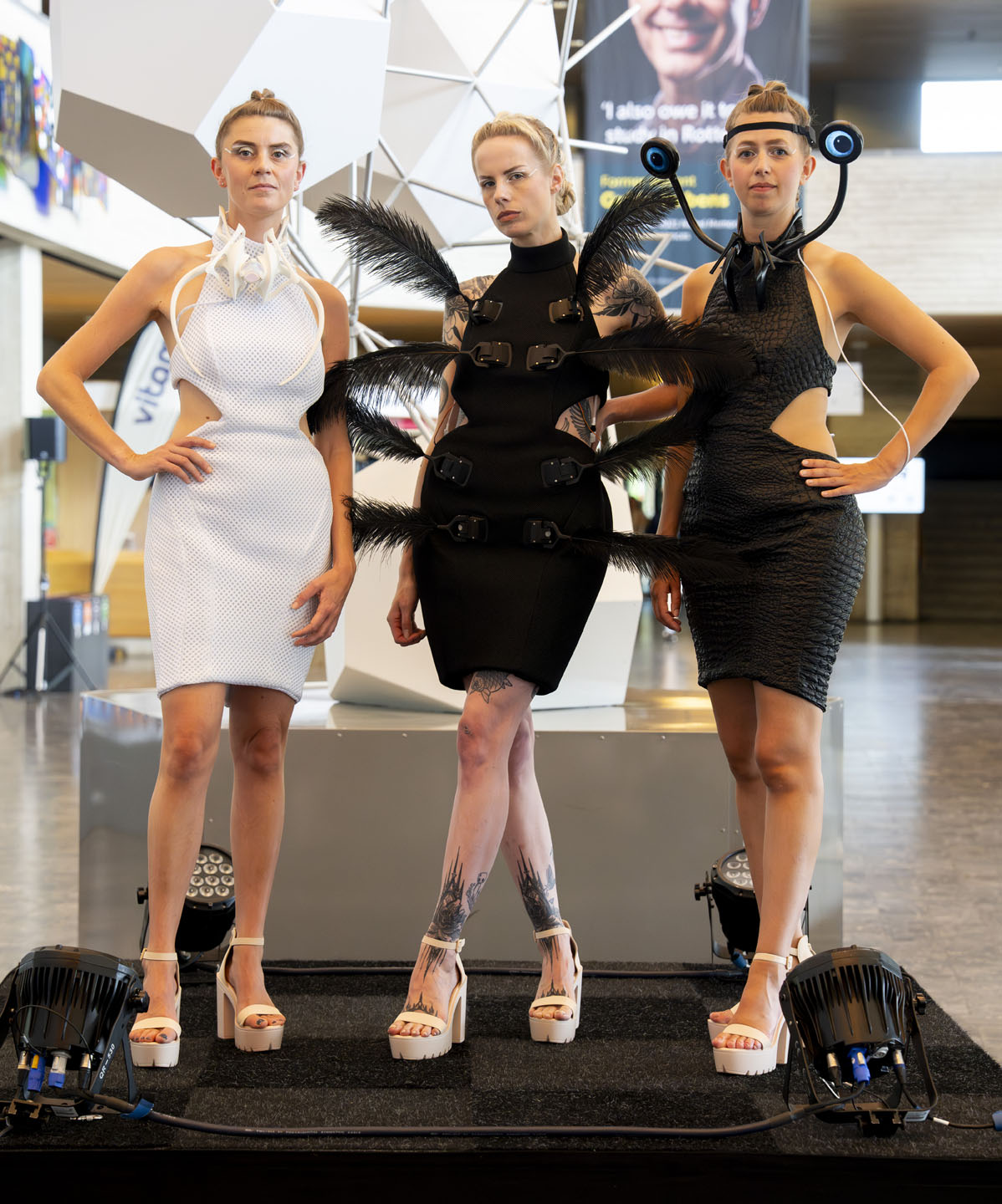
To end the day, participants gathered in the Theil building hallway for a unique live demo – a fashion-meets-technology performance by Dutch designer Anouk Wipprecht. She presented three conceptual dresses that combined robotics, interactivity and wearable technology, leaving the audience inspired and full of wonder at the creative possibilities ahead.