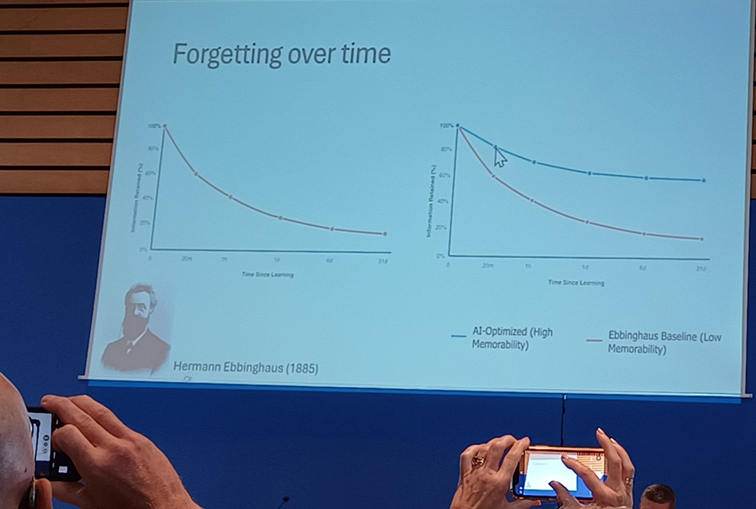
Ebbinghaus would have loved how AI can optimize for memorability
The model he developed predicts which text will be more easily remembered and works on using AI to adjust it. Principles to make images and text more memorable are sometimes obvious, sometimes not. In many of his tests, the most memorable image (for both men and women) was of a ‘Bikini’. Training AI on large-scale memory data has great potential for predication and generation of high impact content to complement learning strategies. I found it a fascinating presentation and encourage you to follow Thomas’ work.
Some pros and cons of Lecture Capture
Since 2015, I’ve been writing my blog, called ‘Video Teaching’. I’m interested in how ‘teaching through the screen’ impacts the learning process. So, I was glad to moderate this session with five expert panellists on the ins and outs of Lecture Capture. We examined Lecture Capture (LC) from three perspectives: the organization, the educator, and the learner. We started looking at the practicalities and reasons for LC but ended up with a much wider reflection on teaching models, paradigm shifts, and the essence of teaching and learning.
Some universities legally require recording of lectures for accessibility while some focus on hybrid virtual classrooms. We discussed what control each educator has in what is recorded, and when they can stop recording, for sensitive in-class interactions. And there are still fears of ‘losing our job if we are recorded’, which I first wrote about in 2015. Has lecture capture improved the live performance of lecturing, or acted as a reflective tool? How do the post-production processes of tagging, subtitles and archiving support the learning experience? And does anyone every actually watch all this recorded material stored on servers for so many years? These were just some of the points in our discussion.
Although this session was not ‘lecture captured’ (there is no recording for you to view), we had a lively discussion with critical input from the audience and panel. With many thanks to Carlos Turró Ribalta, Universitat Politecnica de Valencia, Timo Nogueira, virtUOS, University of Osnabrück, Jean-Marie Cognet, EdTech France, Lars Binau, Technical University of Denmark (DTU), and Leif Kristiansen, Norwegian Agency for Shared Services in Education and Research, Norway (SIKT)).
2 – Latest on AI ethics and more
Dancing in step with AI
According to Tine Baelmans, Vice Rector for Educational Policy at KU Leuven, ‘GenAI takes many to tango!’. KU Leuven, (currently celebrating its 600th year) hosted the conference and the Media and Learning office will move into premises in the University later this year. Tine has been a strong advocate of Media and Learning in her role as vice rector over the last few years. I had a chance at the pre-conference dinner to thank Tine in person for the strong support she has given M&L over the years and will step down from her role as Vice Rector later this year
We should engage, embrace, and not be afraid of AI. Tackling academic misuse cases is still challenging. Chat GPT only took 5 days to reach a million users and KU Leuven were one of the first movers to establish and publish guidelines: with ongoing support, training for staff. AI literacy was a main theme during the conference. Including working on the AI act at a European level to examine security, environmental, ethical aspects and how it impacts the educational paradigm. We should bridge the ‘AI gap’ and not punish those using AI but be aware of the risks. Recent research warns we may become ‘less capable’ as humanity.
Get MCPs and AI agents to do your work for you
Maarten Francq from the Royal Institute for Theatre, Cinema and Sound (RITCS) in Brussels is pursuing a PhD in “AI in Live Entertainment”. His innovative research includes fully AI-generated music videos (check out the very cool video for Belgian artist DAAN). If we do things right, we can spend time relaxing on the beach while AI does all its work for us. Just like he does! Maarten’s lively, provocative and fun presentation woke up the audience as we reflected that we may be a lot further ‘behind the AI hype curve’ than we thought!
You will lose your job to someone who is better at using AI than you are!
Will AI take my job? No. Our jobs won’t be replaced by AI, but we’ll be replaced be people who can work with AI better than we can. Maarten is considering building a clone of himself, so his clone can create the work he’s paid for today. By adding all that he has ever created in his life, to the model, he can set AI to work for him. We should not lose track of where the human is in the loop.
Maarten had us all running to create our own ‘core AI Agents workflow’ via an ‘MCP’ (Model Context Protocol). I had to look up what an MCP is for a good explanation. Basically, an MCP helps AI systems work together more smoothly, replacing the messy one-off fixes we often use today. It lets AI keep track of what it’s doing—even as it switches between different tools and datasets. As this technology develops, AI won’t lose its place when moving between apps—it’ll be like having a consistent memory across tools. The MCP connects to real-world tasks through a central workflow, making the AI more useful in practical ways.
For example, it can link Google’s VEO3 (Video Generator, used here by Imagine.Art and Heygen (AI text to Video Generator). The idea is that AI agents will be able to use these tools directly to create high-quality content. It’s still early days—it’s only June 2025—so let’s check back in six weeks to see how things are progressing.
It is now possible to easily create stories and make movies with CGI for very little money. Imagine livestreaming your favourite film and choosing which actor you’d like to play the main role, as it streams. Or taking a picture of a missing part of your bike, using AI to convert it to 3d code, and then 3d printing it in your home.
It is time to move beyond prompting and integrate AI usage in other ways. Today, most people are using AI tools to substitute what we are already doing, or to help with daily tasks. Now is the time to combine different AI tools to create completely new things. Overall, a very informative presentation (thank you Maarten) and it woke me up. Time to get more plugged in to these developments in order not to be left behind. We shall see!
Ethical and Innovative issues of AI
Andy Thys, KU Leuven moderated the panel on ethical issues in AI. Sonia Hetzner, FAU took us through how AI caught higher education institutions off guard, and now AI-generated assignments pose significant academic integrity challenges. From the initial shock and pain, we have moved to toward experimentation and practical adoption. Using Kotter’s 8 step model of change. We are now entering a more strategic phase that focuses on AI as a structural force reshaping teaching and learning, requiring institutions to rethink curricula, develop AI competencies, and implement long-term, adaptive strategies informed by research and leadership. This includes using frameworks like Kotter’s change model and tools such as AI checklists, while also addressing ethical concerns like bias and discrimination. The “Furth Manifesto“(March 2025) is a guiding document for future pedagogical practices and policy design.
Cornelia Amon, IMC Krems University of Applied Sciences, Austria was involved in designing the iMooX course “AI! But how?”. It offers valuable insights into designing AI-integrated teaching while fostering critical media literacy. AI’s arrival was disruptive but should be treated as another tool in the evolving media landscape—comparable to past shifts with books, radio, and TV. The course encourages students to become critical, ethical users of AI, helping them evaluate tools not just by function but by their data practices, company backgrounds, and ethical implications. Interactive and scaffolded activities—like gamified quizzes, short exercises, and discussion forums—enable engagement, but reflections revealed that content format (e.g., videos) needs careful consideration. The key takeaway: we don’t have to use AI for AI’s sake—pedagogical value and ethical clarity should guide tool selection and course design.
Jessy De Cooker, Fontys Hogeschool, The Netherlands Four dimensions of AI literacy: the dos and don’ts in AI education in J-schools. In journalism education, the integration of AI challenges traditional roles, prompting educators to shift from authoritative knowledge-givers to facilitators of collaborative exploration. AI is shaping the media landscape—including generating fake book lists and mimicking editorial processes—there is an urgent need to define AI literacy within the field. Many educators feel unprepared to teach these tools, yet initiatives such as peer-led learning, flipped classrooms, and interdisciplinary approaches can help develop student and teacher competence. Does AI improve journalistic quality, and how do we manage the ethical and practical risks involved?
The audience asked several times ‘How do we know which AI is good or not?’ I suggested to the panel that we could develop an ‘AI Nutrition Score’ along the lines of NewsGuard (who do the same for media sites). NewsGuard have a thorough, logical and transparent rating system which we could use for AI tools.
Ivana Juraga is Team Leader for the Digital Education Ecosystem and Evidence, Digital Education Unit, at the EU. She zoomed out to the European level and looked at research and reports that are currently being compiled on this subject. She mentioned the (2020) Digital Education plan (2021-2027). Also, the outline of the 2030 Roadmap for the future of digital education and skills which is currently under preparation. Their 2022 publication, ‘Ethical guidelines for educators on using artificial intelligence’ is one of the most downloaded reports from the EU site (update pending in 2025). Ivana reminded us that there is an increasing digital divide. Only 20% of EU children attend schools with internet speeds above 100mbs, and, according to the ‘International computer and information literacy study’, IEA, (2023), 43% of 8th graders lack basic digital skills.
Challenges choosing the right AI
In another workshop, I role-played some additional dilemmas about AI in a business context. We were assigned a role in a software development company, with budget to invest in certain AI tools. Our team looked at which AI tools to buy, with which functionality, for which goals? This was a good way to explore the complex issues of making ethical choices in a fast-shifting world where there is little transparency. Lara Pedraz and Pein Leeuwenburg from Leiden University guided us expertly through the session. I would have liked more time, but their original 90-minute concept had to be squeezed into 60. Such is conference life.
3 – XR use cases and dilemmas
Digital Twins and immersive learning experiences
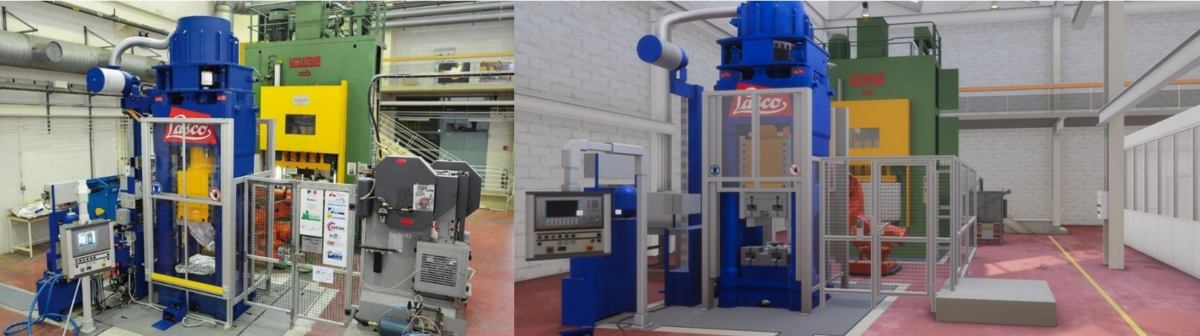
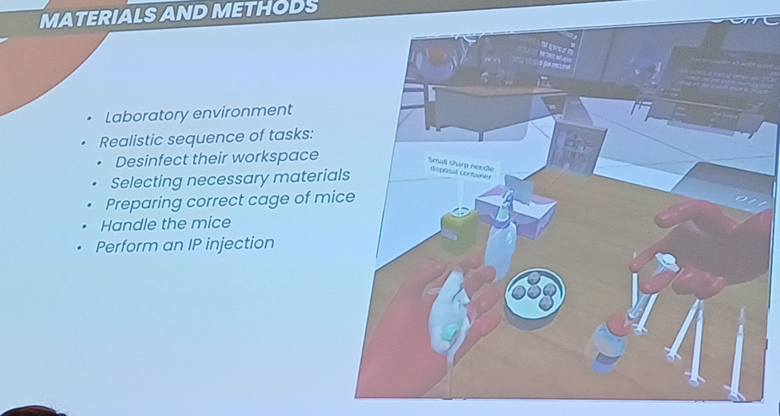
Thierry Koscielniak is President of France Immersive Learning / Executive Advisor, Arts et Metiers Institute of Technology. He showed examples of how they are using AI and technology to create immersive learning experiences. Combining the power of virtual, augmented, and mixed realities transcends traditional learning media, offering deeply engaging, experiential learning which can enhance retention and engagement.
Polling the conference audience, Theirry saw that about 20-30% of us had a VR headset at home. He stated that when this reaches 90%, then VR will finally start to connect in education.