by Ines Springael, Breda University of Applied Sciences, the Netherlands.
This article is part of the “Centres for Teaching and Learning” series, a collection of interviews and articles exploring the diverse roles and innovative practices of CTLs, presented by the Media and Learning CTL Special Interest Group. In this series, we invite one of our members each month to introduce their CTL, describe the work they do and to highlight some of the challenges they face.
When I took on the leadership of CTL at BUas, I did not inherent a blank slate, but two functioning programmes that had been running in two years, each doing important work, each with its own momentum.
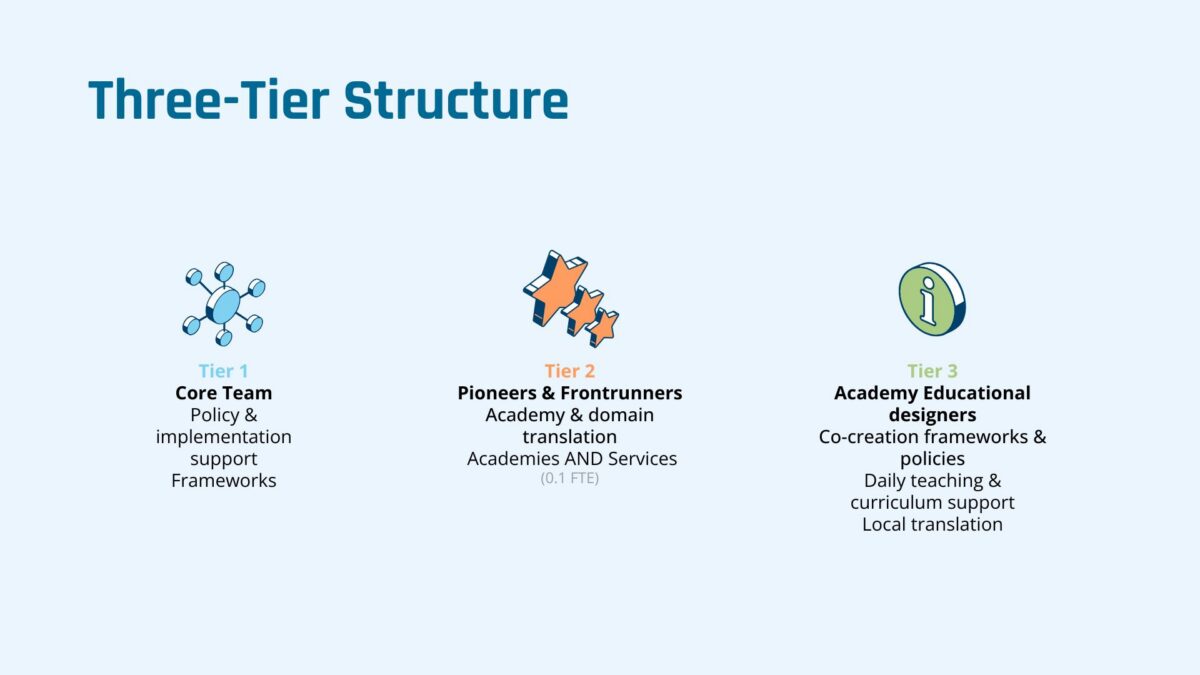
One was our AI Programme, which we had been building and I was leading since 2023. By the time the merge happened, it was operating at scale — around 7,500 users institution-wide using an LLM, with an AI training infrastructure, an ethics and education policy, and a network of AI Pioneers embedded across our five academies. The other was a Community for Teaching and Learning, a more emergent structure built on peer learning networks and grassroots faculty initiatives, with frontrunner ambassadors connecting across disciplines.
Both were valuable. Both had real engagement. But they were operating separately. Competing for faculty attention, duplicating some efforts, and creating confusion about where people should go for support. Educational support at BUas was scattered across the AI Programme, P&O training, academy-based educational designers, and multiple communication roles. Faculty were asking a reasonable question: where do I go for help?
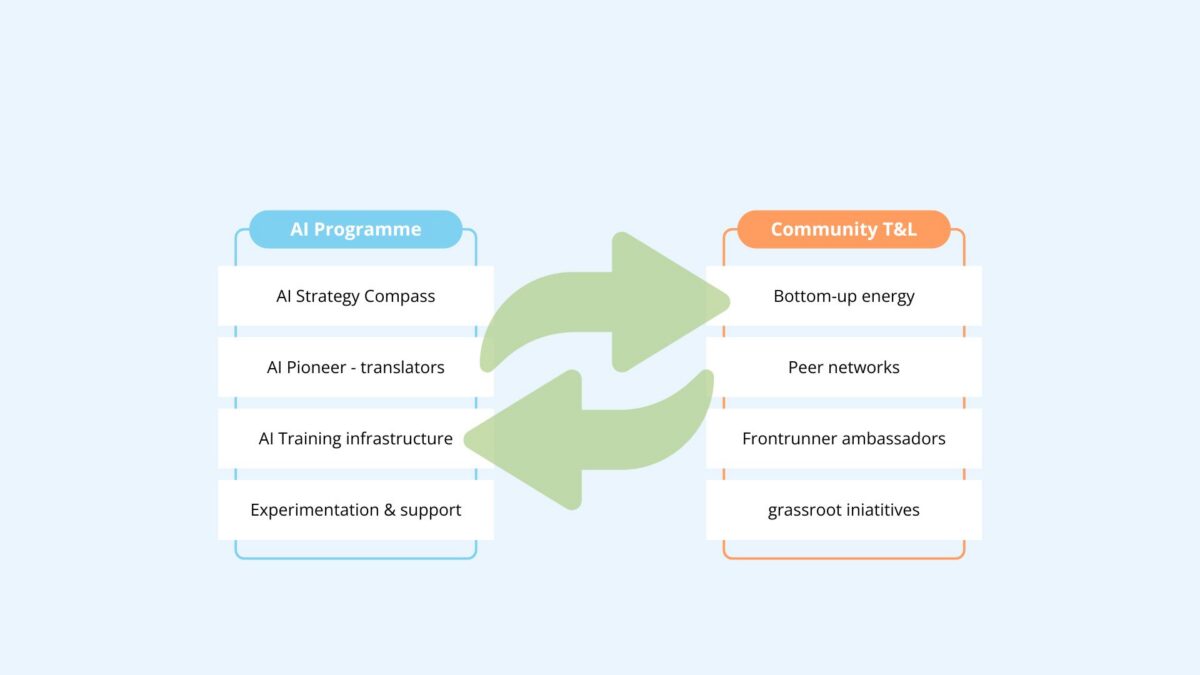
The answer we arrived at was not to choose between the two programmes, or to let one absorb the other. The integration decision was about recognising that each brought something the other lacked and that together they could create something neither could be alone.
What the AI Programme brought was professional infrastructure: the AI Strategy Compass as a guiding framework, a training team, structured experimentation and support, and the capacity to work at institutional scale. What the Community for Teaching and Learning brought was bottom-up energy: peer networks, faculty frontrunners with local credibility, and authentic community connection.