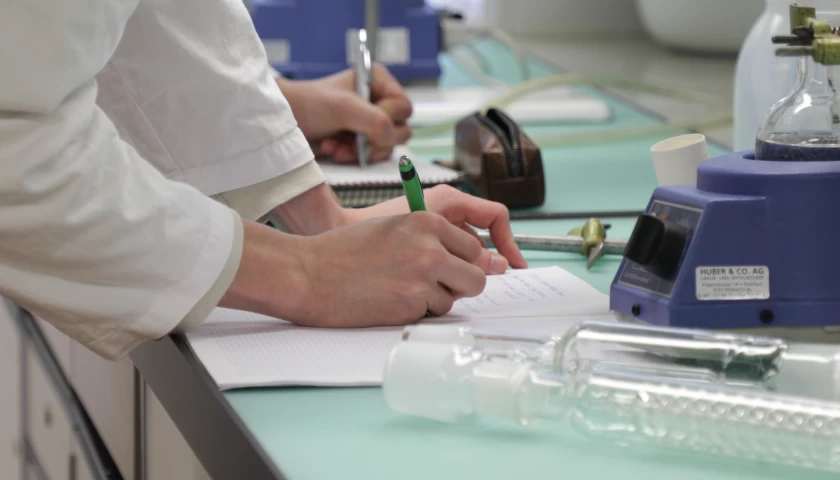
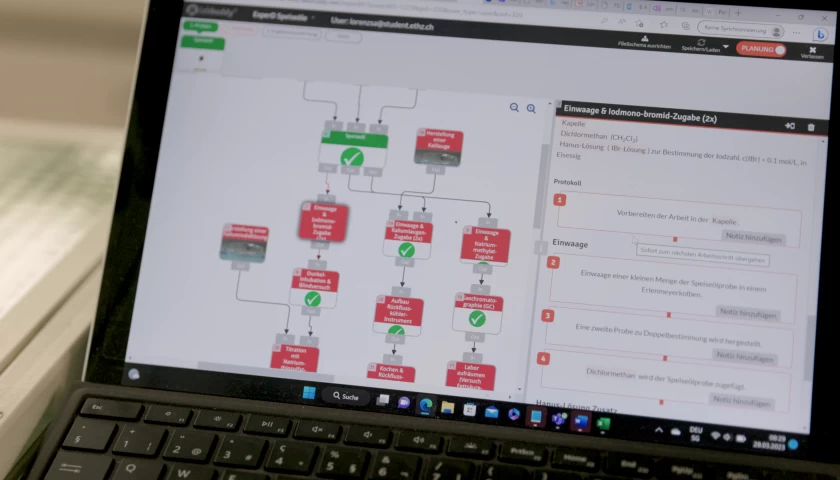
To support this transition, the teaching team introduced “LabBuddy”, an interactive e-learning tool. The tool provides scaffolding in flexible degrees, guidance and immediate feedback to the students, empowering them to come to the lab class, fully prepared, running the experiments with very little support. The new design brought an immediate change in student engagement. Instead of passively executing predefined steps, students had to prepare their experiments in advance.
Although there was some initial resistance from the students to the time investment for the preparation tasks, the active engagement in the experiment design led to a deeper understanding of the single steps in the experiment and the overall concepts.
“In the lab reports, it was noticeable that the students had studied the topic in depth.”
(Lab Assistant quote)
The lab assistants were impressed by the focused and thorough work and the new learning culture in the classroom. Previously, much of the time in class was spent addressing basic, procedural questions—such as where to find equipment or how to execute specific steps.
With students now arriving well-prepared, class time could be used more effectively for higher-level discussions and problem-solving.
The students also reported a significant improvement in their learning experience.
One participant reflected:
“LabBuddy gave me the opportunity to think about why I was doing it at each step and I did not just get a ready-made protocol to work with”.
The role of LabBuddy in supporting active learning
LabBuddy, initially a spin-off at the Laboratory of Food Chemistry at Wageningen University, has now become a widely adopted e-learning solution across various European universities.
The tool enables active learning and focused work in the laboratory, helps to reduce cognitive load, and empowers students to formulate their own experimental designs before they enter the lab. Departing from the cookbook-style, this approach nurtures preparedness, critical thinking, and a deeper understanding of the rationale behind each experiment.
Instructors can identify difficulties through the tool and support students on an individual level, using the time freed up by eliminating low-level questions.
Students build confidence through constructive feedback, marking a significant shift towards student-centered, active learning.