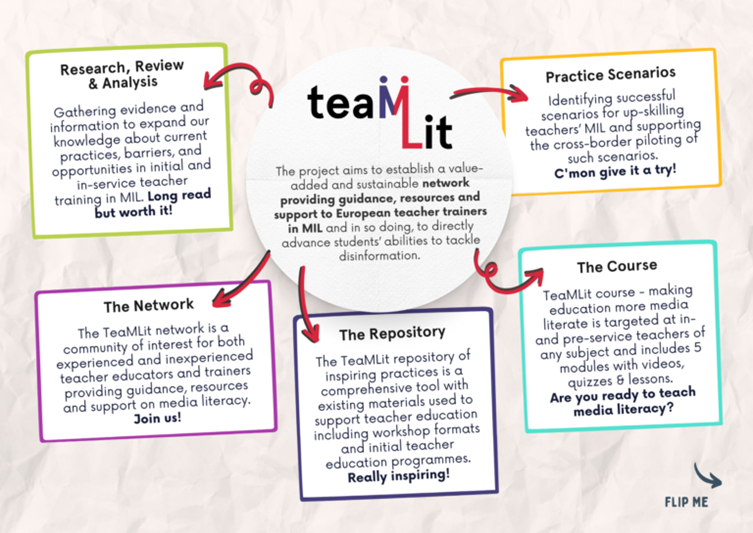
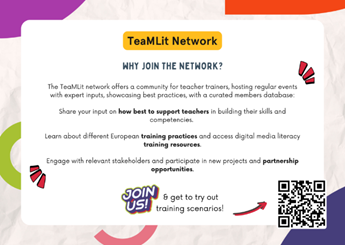
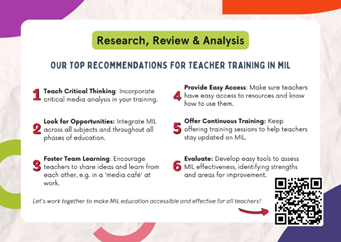
These reports have helped to identify successful training scenarios and revealed where significant gaps remain. They provide concrete evidence for policymakers and training providers alike, demonstrating the need for more structured approaches to MIL, better integration into curricula, and stronger institutional support for teacher educators.
Recent findings from the TeaMLit project show that media literacy is becoming widely recognised as an essential part of education in all the countries that were looked at. It’s seen not just as a standalone subject, but as a key skill that should be integrated into all areas of the curriculum. As Dr. Lina Pranaitytė, scientific coordinator and researcher at the Heidelberg School of Education (Germany), explains:
TeaMLit research has shown that media literacy is understood as a significant part of education in all our researched countries, considering it as a cross-disciplinary competence to be acquired in the curricula of all subjects and throughout all phases of education. Respectfully, all teachers should, but not all are, sufficiently prepared for the dynamics of the current media world in both pre-service education and continuous professional development. Moreover, the lack of exchange between the experiences of in-service teachers and the preparation of pre-service teachers hampers the development of coherent, critically informed media education that facilitates the education of empowered and responsible citizens in democratic societies.
A free online course for all teachers
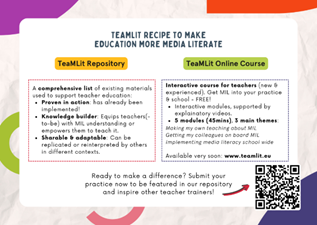
Perhaps the most tangible and accessible outcome of TeaMLit is the development of a brand-new online course: “Making Education More Media Literate.” This self-paced, free course is designed to support teachers at all stages of their careers, whether they’re completely new to media literacy or already integrating it into their practice and looking to go further.
The course is made up of five interactive modules, covering key aspects of MIL in education:
- Introduction to Media Literacy – What is it, and why does it matter for teaching?
- Understanding Students and Their Needs – How to embed MIL into the curriculum and everyday classroom life.
- Teachers and Media Literacy – Pedagogical approaches, teaching strategies, and practical examples.
- Engaging Your Colleagues – How to build momentum for MIL within your teaching team or school, using motivational frameworks like self-determination theory.
- Media Literacy at a School Level – How to shape a whole-school approach to MIL, including policy and planning.